Termites are the one pest in Jefferson where sealing the house does not solve the problem. Mice, stink bugs and camel crickets come through gaps you can find with a flashlight and a tube of sealant. Subterranean…
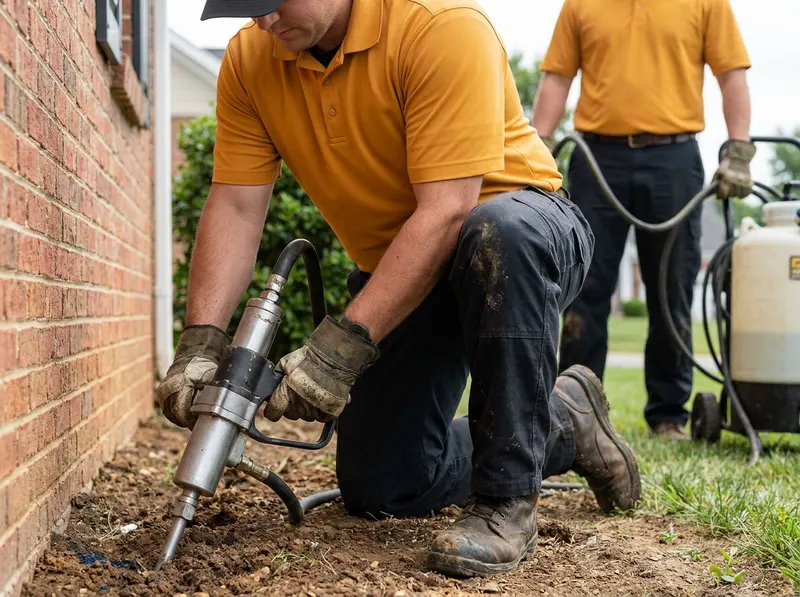
Termites are the one pest in Jefferson where sealing the house does not solve the problem. Mice, stink bugs and camel crickets come through gaps you can find with a flashlight and a tube of sealant. Subterranean termites come up from the soil beneath the footing, build shelter tubes of mud and saliva up the inside of a foundation wall, and reach the sill plate without ever crossing open air. That is why the fix for termites is a treated soil zone and corrected grade, not exclusion work. Along the Catoctin Creek valley farmsteads and on the older homes off Old Middletown Road, the finds are consistent: fieldstone and mortar basement walls with mud tubes tracking the joints, dirt-floor crawlspaces holding humidity through summer, and porch posts or wooden steps set straight into grade. On the newer subdivisions along the Holter Road corridor and around Broad Run and Mountville, the entry points shift to slab expansion joints at attached garages, bath plumbing penetrations, and mulch beds piled above the top of the foundation.
The decision is usually liquid barrier versus bait system. A liquid soil treatment means digging a narrow trench against the foundation, treating the soil, and drilling through any concrete — sidewalk, patio, garage slab — where the trench cannot continue. It kills termites that contact the treated zone and it works on a known, active infestation quickly. The trade-off is disruption: drilling patched holes in a finished patio, and pulling back landscaping along the treated side. A bait system means installing stations in the soil every ten feet or so around the structure, which avoids drilling and suits homes where flagstone, decking or mature plantings ring the foundation. Baits work through the colony instead of against a barrier, which takes weeks to months, and they only keep working if someone comes back to check and refill the stations. For a Jefferson farmhouse with an accessible dirt perimeter and active tubes on the wall, liquid is normally the faster and cheaper answer. For a 1990s home on Poffenberger Road with a wraparound concrete apron, a bait system often costs less to install than the drilling would.
Spot treatment has a real place and a real limit. If the activity is confined to one porch post, one basement window frame, or a single band of sill plate near a downspout that has been dumping against the wall, treating that area and fixing the water is honest work at a fair price. If mud tubes appear at three separate points on two walls, spot treatment is a way to spend money twice. The inspection is what settles it, and the inspection happens before any number is quoted.
Swarming season is the moment most Jefferson homeowners find out. Winged swarmers show up on warm, humid afternoons from roughly March into May, often the day after rain, and they collect at basement windows, sliding door tracks and light fixtures. A swarm indoors means an established colony inside or under the structure — not a colony flying in from the woods along the South Mountain treeline. Winged termites indoors are evidence of an existing colony, not a new arrival. If that is what you are looking at in Petersville, Lander, or along the Burkittsville Road corridor, get it inspected during swarm season rather than waiting for the wings to disappear from the sill, because the colony does not leave with them.
Every job gets a firm, written price after a free on-site visit.
Tell us about your termite treatment job in Jefferson and we'll send a clear, written quote — usually the same day.
 Kryvex Bug Defense